Healing Lab
Healing is not simply the absence of illness or suffering. It is the restoration of wholeness - within ourselves, between one another, and with the wider living world.
About this Lab:
The Healing Lab is a collaborative space for exploring one of the defining questions of our time:
What does it take for people, communities, cultures and living systems to heal - and how might we create the conditions in which healing becomes possible?
We understand healing not simply as the treatment of illness or the repair of individual wounds, but as a movement towards greater wholeness, relationship, coherence and vitality.
Human beings do not heal in isolation. Our wellbeing is shaped by our bodies and nervous systems, our relationships and communities, our histories and cultures, our sense of meaning and belonging, the institutions and economic systems within which we live, and our relationship with the wider living world.
The Healing Lab therefore approaches healing ecosystemically.
It brings together insights from medicine and public health, psychology and neuroscience, trauma studies, relational and developmental science, contemplative and spiritual traditions, Indigenous and ancestral wisdom, the arts, nature-based practice, community healing and systems thinking. Rather than seeking a single theory or methodology, the Lab asks what these different traditions can teach us about humanity’s innate capacities for restoration, reconciliation, regeneration and growth.
A central concern is the relationship between wounding and the conditions that produce it. Many contemporary difficulties cannot adequately be understood solely at the level of the individual. Loneliness, chronic stress, burnout, polarisation, displacement, ecological grief, intergenerational and collective trauma, loss of meaning and disconnection from nature may also reveal something about the systems and cultures within which people are trying to live.
Healing therefore asks more than how do we help people cope?
It also asks:
What needs to change in the conditions of life so that people and communities are less continually wounded in the first place?
From this perspective, healing has both a restorative and a generative dimension. It involves tending what has been harmed, excluded or fragmented, while also restoring the relational capacities through which life can flourish: safety, trust, compassion, belonging, meaning, agency, creativity, reciprocity and participation.
The Lab is particularly interested in the connections between personal, relational, ancestral, collective, systemic and ecological healing. It explores how unresolved trauma and historical experience can become embedded within families, cultures and institutions; how patterns of separation and othering perpetuate harm; and how processes of witnessing, reconciliation, compassion and reconnection can open new possibilities.
Yet the Lab does not define humanity primarily through trauma.
Alongside the study of wounding, it seeks to understand the extraordinary human capacities for resilience, love, care, imagination, forgiveness, meaning-making, post-traumatic growth, and regeneration. Healing is therefore approached not simply as recovery from what has happened, but as the restoration and strengthening of our capacity to participate more fully and wisely in life.
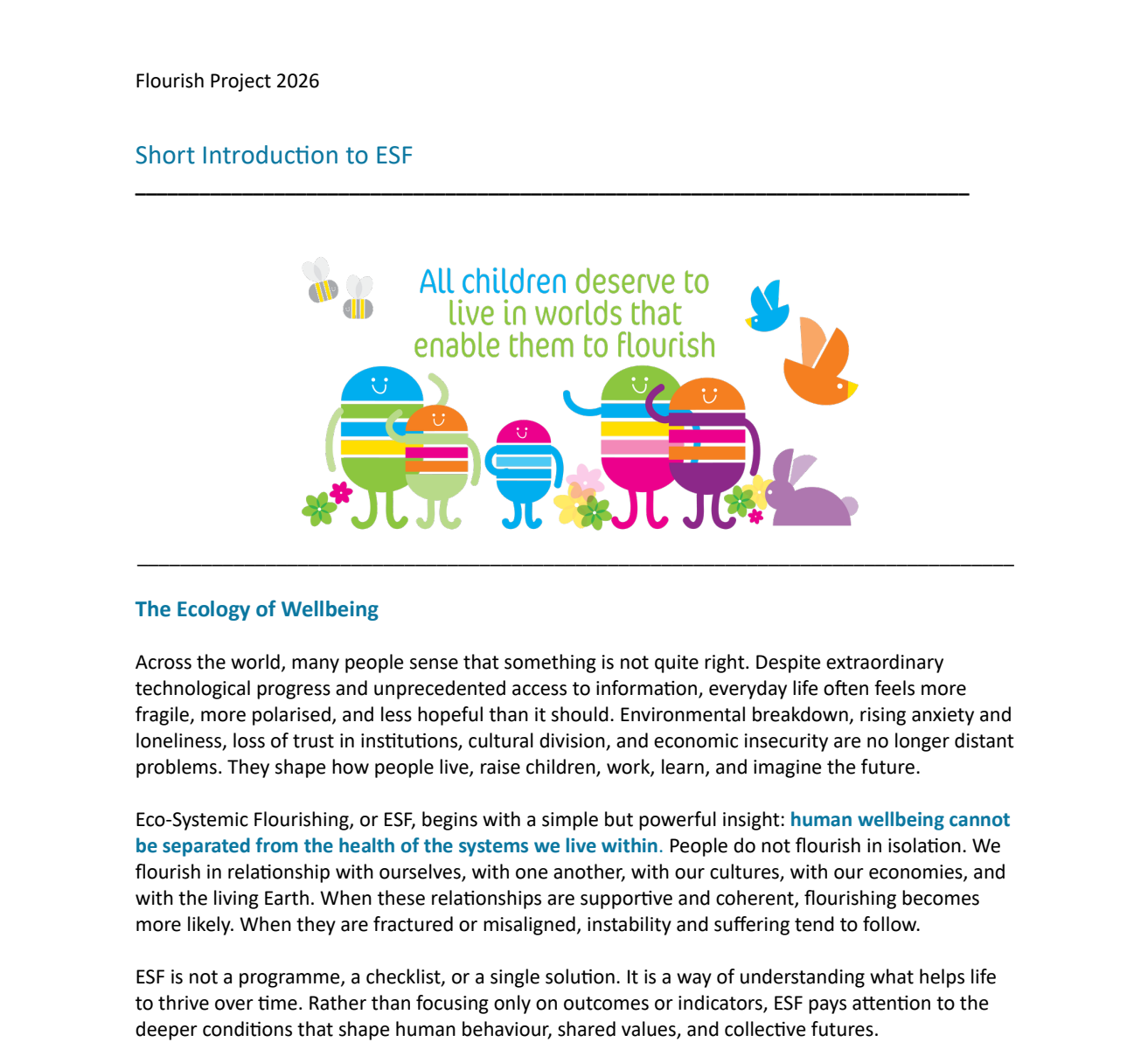
Within the wider Ecosystemic Flourishing (ESF) Framework, healing can consequently be understood as a relational process: restoring healthier relationships within ourselves, between people, across generations and cultures, within our institutions, and between humanity and the living Earth.
a richer understanding of the conditions for healing—and how those conditions might be cultivated within families, communities, organisations, institutions,The longer-term ambition of the Healing Lab is to contribute to a more integratedunderstanding of healing cultures: communities and societies that do notsimply intervene after harm has occurred, but actively cultivate the conditionsthat protect and regenerate human and planetary wellbeing.
This could encompass research, dialogue, lived practice, storytelling, community initiatives, cross-cultural learning and the development of practical approaches that can be shared across sectors and societies.
The Lab would provide a meeting place between people and perspectives that do not always find themselves in the same conversation: clinicians and healers; scientists and contemplatives; trauma practitioners and systems thinkers; Indigenous knowledge holders and researchers; artists and community leaders; educators and policymakers; and people whose deepest knowledge of healing comes through lived experience.
The intention would not be to collapse these perspectives into a universal model. Rather, it would be to enable them to encounter one another with sufficient openness, humility and rigour that deeper patterns, principles and possibilities can become visible.
This creates the possibility of moving beyond isolated interventions towards a richer understanding of the conditions for healing — and of how those conditions might be cultivated within families, communities, organisations, institutions and wider society.
Global Healing Day
Acentral public expression of the Healing Lab is Global Healing Day - an annual invitation for people andcommunities across the world to pause, connect, witness, remember andparticipate in acts of healing. Rather than becoming another internationalawareness day, Global Healing Day is being developed as a distributed globalpractice.
Communities will be invited to interpret healing within their own cultural and ecological contexts: through conversation and silence, music and art, ceremony and contemplation, intergenerational gathering, reconciliation, community service, connection with nature, storytelling, remembrance or collective action.
Local expressions could therefore be radically diverse while sharing a simple underlying intention:to restore relationship where relationship has been to restore relationship where relationship has beenwounded or lost.
Global Healing Day is being created as space for the personal and collective, the joyful and the painful, remembrance and possibility. It acknowledges historical and continuing wounds without allowing humanity’s story to become defined solely by them. Over time, it is hoped that the Day could become both a global gathering and a living inquiry. Stories, practices and learning from participating communities could contribute to a growing body of understanding about what healing means across cultures, generations and contexts.
A Collaborative Global Platform
The Healing Lab is conceived not as something the Flourish Project seeks to own, but as a collaborative platform capable of bringing together organisations, communities, practitioners, researchers, and wisdom traditions already collaborative platform capable of bringing together organisations,communities, practitioners, researchers and wisdom traditions alreadycontributing to different dimensions of healing. Its distinctive role would be one of connection and integration.
There is already profound expertise in trauma, health, spirituality, peacebuilding, reconciliation, ecology, community development, contemplative practice, Indigenous knowledge, and systems transformation. What is less common is a shared space in which these different understandings of healing can meet and illuminate one another. The Healing Lab could help create that space. Through dialogue, inquiry, research, convening and shared experimentation, it could explore whether deeper principles of healing become visible across apparently different contexts- while respecting the cultural specificity and integrity of different traditions and practices.
This could gradually contribute towards a richer global understanding of healing: not as a single intervention or discipline, but as a fundamental fundamentalregenerative capacity of living systems. The larger question is therefore not simply how humanity responds to illness, trauma or breakdown. It is how we might consciously cultivate the relational, cultural, ecological and systemic conditions through which people and planet can continually restore connection, coherence and vitality.
The aspiration of the Healing Lab is ultimately simple but profound: not merely to heal what has been wounded, but to cultivate a world that wounds less - and that increasingly supports the capacity of life to regenerate, reconnect and flourish.
Monthly Healing Circles
Held monthly, the Healing Circles are 90-minute facilitated gatherings that explore healing across its many interconnected dimensions: personal, relational, ancestral, collective, systemic and ecological.
Each circle offers a space to look honestly at how unresolved trauma and historical experience become embedded within families, cultures and institutions, and how patterns of separation and othering continue to perpetuate harm. Together, participants explore how witnessing, reconciliation, compassion and reconnection can open new possibilities for individuals, relationships and the wider systems we belong to.


Join our newsletter to stay up to date on features and releases
By subscribing you agree to our Privacy Policy